“Perfection is the child of time.” – Joseph Hall
Three things have really captured my attention as of late. One: the freedoms associated with working a private sector job or being one’s own boss. There has to be a terrific brand of independence – and grief – brought about by such work. Two: music in video games. I’m not just talking about a single song or the score, I mean the music as a whole. Third: whether or not porn stars are the new civil rights leaders. That last one warrants plenty of conversation what with the rise in popularity for the lovely Ms. Mia Khalifa, but that’s a conversation for another day. Let’s go back to the music.
As someone who has played video games for years, there’s a special place in my heart for the music from the 16-bit era onward. My favorite song from Street Fighter II is still Ryu’s theme (don’t be so surprised) and I can still recite the soundtrack to Streets of Rage 2 by heart with nothing more than a sudden memory. The music is just as important as the game itself: music is designed to spark a greater immersion for the material. That’s why I like Ryu’s theme: I can totally believe a song like that playing while two people fight on a rooftop in Japan. All that going on at an air base though? I have my doubts.
I may or may not have said it before, but Chrono Cross is one of my favorite video games. A long time fan of RPGs, Cross combined everything I was looking for in an era of Final Fantasy, Legend of Dragoon and whatever else was dominating the scene at the time. It was bright, vibrant and colorful so it was a feast for the eyes. It was a spiritual sequel (definition: same general world) to the lauded Chrono Trigger and flipped the script almost entirely with a huge cast of playable characters (Trigger was thankfully limited) and a more cerebral (read: open to interpretation) plot was introduced. The main protagonists were silent in both efforts, while the deuteragonists were both active, talkative, pushy blondes. Have to admit: there’s something special about a game that can successfully make you attribute an Aussie accent to a character who’s voice you never actually hear. Square is a hell of a company.
Oh, and they both deal with time travel. You know, if the “chrono” bit was lost on you.
I didn’t play the game when it first came out: it was part of a collection of games I received for Christmas many years ago. It was on the backburner while I played the more traditional Final Fantasy games, and the relatively new Kingdom Hearts games, and the teen base lust fueled Parasite Eve, and I can say with confidence that I never actually finished the last one. By the time I got to Cross I had no intention of really playing it so much as just rushing through it because, much like food, I hate letting things waste away when they’re in my possession: its why I try to avoid snacks now. I was a few hours into it the first time before I really realized how significant the effort really was; the game. It’s so easy to dismiss a Square-Enix project (back then they were still Squaresoft) that doesn’t carry the name Fantasy (and that ain’t doing so hot right now either), but if you slow your role a bit and actually sit through the opening sequence instead of just speeding through it…
Well, now we get into the music. “Time’s Scar” serves as both the opening sequence song, and the first track on the three disc soundtrack. What begins with a subtle ambience and a flute (or piccolo, it IS pretty high pitched) solo that glides over the acoustic guitar loop and brief instance of chimes ends as suddenly as it begins, and then come the drums, and the intensity builds into an orchestral fury led by a violin that seems to blend indigenous folk and earthy spiritualty into their soulful playing. In regards to video games, I put the song right up there with “Bohemian Rhapsody” and “The Dancing Girl”, by Queen and Terry Callier respectively, for how it begins with a slow, easy groove and builds into a chaotic epic, but still manages to come down as smoothly as it ascended, and considering my great respect for Queen and near religious reverence for Terry Callier, that’s a major compliment.
Huge.
Chrono Cross focuses a lot on water. The world map is rather similar to a world map for us humans: you have some major land masses and a lot of water in-between. You travel through that water on a tiny boat to get around, and you don’t really need me to tell you that part I’m sure. As a result, much of the ambient music has a coastal or nautical feel to it, and that theme is expounded on with the prevalence of songs that invoke the spirit of small villages or small island communities. Larger scale tunes are reserved for large areas, major hubs and major cities. The running motif, as with most good soundtracks, is that of “Time’s Scar”, being rehashed in various formats such as the melancholy “Lost Fragments”, a somber little jiggle that fits perfectly as a slow walk through a sad locale.
And yet, Cross has a varied soundtrack that could give the whole of the Cowboy Bebop musical suite a run for its money as being the most eclectic. “Snake Remains Chamber” fits as a spy movie mainstay and “Ghost Ship” works as a more comedic spy movie mainstay: either way its perfect for Tom Cruise. Video game soundtracks are tricky business: every song has to be accounted for and utilized properly to make every moment both memorable and special, without getting in the way of the game itself. And so far I’ve done nothing but cover disc one.
By the time you listen to disc two (assuming you’re listening the soundtrack and not playing the game (in which case I say “SHAME ON YOU!”)) you begin to notice more and more elements of eastern cultural influences on the music. These influences range from Japanese to Chinese to Indian to the major Pacific Islands, and rather than blend the tracks to incorporate into singular themes the individual islands, locations and areas all have their own individual styles to them, making them feel all the more unique and independent. Add to this the element of time travel. You have the “Home World” and “Another World”, and each world has its own music, so you can visit the same place across dimensions and you have different tunes, but the cultural style remains the same. I mean, it really made the game a thrill to play, and I spent hours just…
Well I thought it was interesting!
Just like the music was individualized for locations, sometimes the goal was to break from the mostly serious vibe the game played up. “Optimism” is a Mickey Mouse march just waiting to happen, and “Zelbess” is so peppy and bloated with Moroccan vibes that you might find yourself jumping up and shaking like a belly dancer. As a matter of fact, I encourage it. Get down with your bad self. Raise up, get yourself together, and drive that funky soul.
Square is no stranger to including a direct “musician” into their games: that’s to say, Final Fantasy VIII had “Eyes on Me” as performed by Julia Heartilly, whereas X-2 had “1000 Words”. I’m not going to say anything bad about the latter: I’m just going to say that it was pure pop. Leave it at that. Cross broke that mold a bit with “Magical Dreamers”, a rock track performed by in-game character Nikki, who talks like Slash and occasionally speaks in song lyrics, notably “Sweet Child O’Mine”. The song itself is fun, but suffers from the same effect of “1000 Words”, albeit less tacked on, and its attached to a better game. Okay, maybe I do still have some words about “1000 Words”.
The centerpiece to disc two is “Chronomantique”, a world roaming song that continues the nautical theme the music primarily follows. To echo Garnet’s sentiment to the strange combination of Steven and Connie, this song is an experience. No other song on the project carries the feel of the open ocean and the friendly island surroundings as well as this one; it stands as a fine contemporary to the far too short “Port 51” off of Uyama Hiroto’s A Son of the Sun album.
And now we get to disc three, and here’s where things get (more) emotional. When the first track is called “Garden of God” (and you have to remember that we’re dealing with translations here) and it is the song you first heard at the game’s start menu, you begin to really grasp the emotive appeal of the game. At this point the music on the discs follows the in-game directions pretty cleanly, so at this point one of you major characters has been brought back from the brink of death, they’ve discovered their heritage, connections have been violently made between this and Chrono Trigger and now you’re being forced to fight a character who wanted nothing more than to help the world, and can’t help but fight in order to help his attackers succeed. And this is all before you get to one of the first late game bosses who literally goes by the name FATE.
Good stories, my friends, always feature that kind of build-up. At this point in the game you’ve transcended the happy islands and descended into the scary landscapes of stopped oceans and computers designed by vengeful deities that would make Galactus envious. And I have to make you realize how important “stopped oceans” is: these oceans weren’t frozen. They were stopped. They were frozen in time, not state of matter, and you have to navigate this on foot. Bloop be damned: that’s scary.
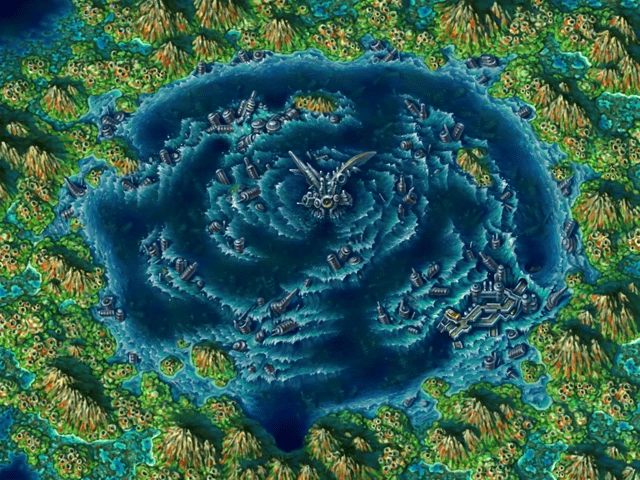
All the same, as this disc follows the game pretty closely, we’re pushing the finish line so the music grows in two directions: tense and triumphant. The tense music comes in the form of tracks like “Burning Orphanage” (yes, its about what you think its about: Aquaman and elephant tusks) and “FATE”, which plays when you are dueling FATE. The triumphant comes in one of the optional final tracks “Life”, which you hear if you finish the game “correctly”. At only one time in the entire game do the tense and triumphant blend, and that’s with the song that plays as you race to the end “The Dream that Time Dreams”. While “Life” restates the brilliance of “Time’s Scar”, “Dream” is the rallying cry. It’s the song that prompts the idea that the characters are joining together to assault the final boss, who shall remain unnamed so you can go back and experience this Playstation classic.
But much like discs one and two had a centerpiece, disc three has “The Girl Who Stole the Stars”, a heartbreaking ballad that wordlessly manages to give all the backstory, anguish, hope and fears of main character Kid in a song that stands mostly as a duet between a violinist and a pianist. Often I say that Red Dead Redemption has one of the finest moments in music with Marston first riding into Mexico, but I often forget to mention how significant this song is, especially when it plays when the two main characters converse.
That being said, the three disc set comes to a close with “Radical Dreamers”, the sole vocal track and a standout piece in Square’s grand musical history. There really aren’t any words for it in terms of quality: the lyrics center around the promise Kid makes to main character Serge to return to him one day, and as it plays over the closing credits the theme of time travel plays out through pictures and video clips, and it sells the feeling. Is it as emotional as “Stole the Stars”? Depends on your perception. For me it falls slightly short but there’s been a running motif of general minimalism with the most emotional tracks, this being no different. One vocalist and one guitarist make this track something precious.
Also, there’s this instrumental variation:
I fell in love with this game after the whole of it, but the music drew me in first. It didn’t have to be so good, but what do you expect? Yasunori Mitsuda, whom I didn’t name until now so you could really appreciate their work, would go on to do the music for a number of games, and he was already involved with plenty of work before even this, but this is something of a masterpiece. Every song is perfectly crafted to be a flawless compliment to the scene associated with it, to the character that calls it a theme, and to the visuals that surround it. Honestly I’ve never heard leitmotifs utilized so beautifully.
And I’ve listened to every Final Fantasy soundtrack ever.

 Weight in Words: Redux
