And would I be sure that this is love, beyond compa, peh, peh; still can’t used to hit that note!
My first foray into the music of the fabled vocal group was through my favorite sitcom, Sanford and Son. Fred Sanford sang their biggest hit “If I Didn’t Care” on several episodes, sometimes missing that note, sometimes going an octave lower so he could hit it without incident. Perhaps it was Redd Foxx’s olive oily buzzard voice but at the time I was not the kind of guy that wanted to listen to anything the Ink Spots did. Thankfully this changed long before the dawn of Fallout 3 and the Bioshock franchise.
The Ink Spots had a rather lengthy career as a concept, ranging from the mid-30s to the mid-50s. The original line up came about in Indianapolis, with Orville Jones, Charlie Fuqua, Ivory Watson and Jerry Daniels. Here where it gets a little funny too. See, Daniels and Fuqua were a duo that did shows around the area in 1931. Jones and Watson were, at the time, part of a quartet called the Four Riff Brothers. In ’33, that quartet broke up, and Watson, Fuqua and Daniels got together to form a new group with a comedy angle called “King, Jack and Jester”. Eventually Jones came into the fray, and after showing up at the Apollo Theater in ’34, Paul Whiteman asked them to change their name to “The Four Ink Spots” because he had a group called “The King’s Jesters”. Seriously, were pre-doo-wop groups so popular and diverse that two groups had a name referring to jesters?
In ’35, they recorded for Victor Records, and they were popular but, ultimately flopping, somewhat like Isaac Hayes did with his first album. But then the heart and soul of the group (like Fatlip to the Pharcyde, or Michael Jackson to the Jackson 5, or Michael Jackon to DeBarge, or Michael Jackson to Rockwell) came in a year later as Jerry Daniels was replaced. This man’s name was Bill Kenny. In a sense, you could say that his inclusion propelled the group to international success and stardom (like Michael Jac… you get the point). See, at the time, the group was known for more uptempo songs, “jive” songs as they were called. Bill Kenny introduced more ballads and a style he called “Top & Bottom”. This is likely the greatest asset and liability to the Ink Spots most popular songs. The Ink Spots were known for two things, aside from Bill Kenny’s high tenor singing. One was the four-bar guitar riff, that was always followed by Kenny’s show stealing voice, and the other was “Top & Bottom”, which made sure that Kenny or fellow tenor Watson and bass singer Jones would stand out. In short, it had the tenor sing the song, then the bass singer “recite” the same lyrics, sometimes offering a minor ad-lib. You might be surprised to know that it wasn’t an immediate success in terms of format, but that all changed in ’39 with “If I Didn’t Care”.
It’s hard to overstate how big this song was. In the late 30s, early 40s, it sold over 19 million copies and was, at the time, one of the biggest selling singles of all time. It never reached number one in the pop charts (stayed at #2, funny enough). The group was paid well, the trademark “Top & Bottom” style was branded on the group like a tattoo, and from 1939 to 1954 the vast majority of their songs followed the same format.
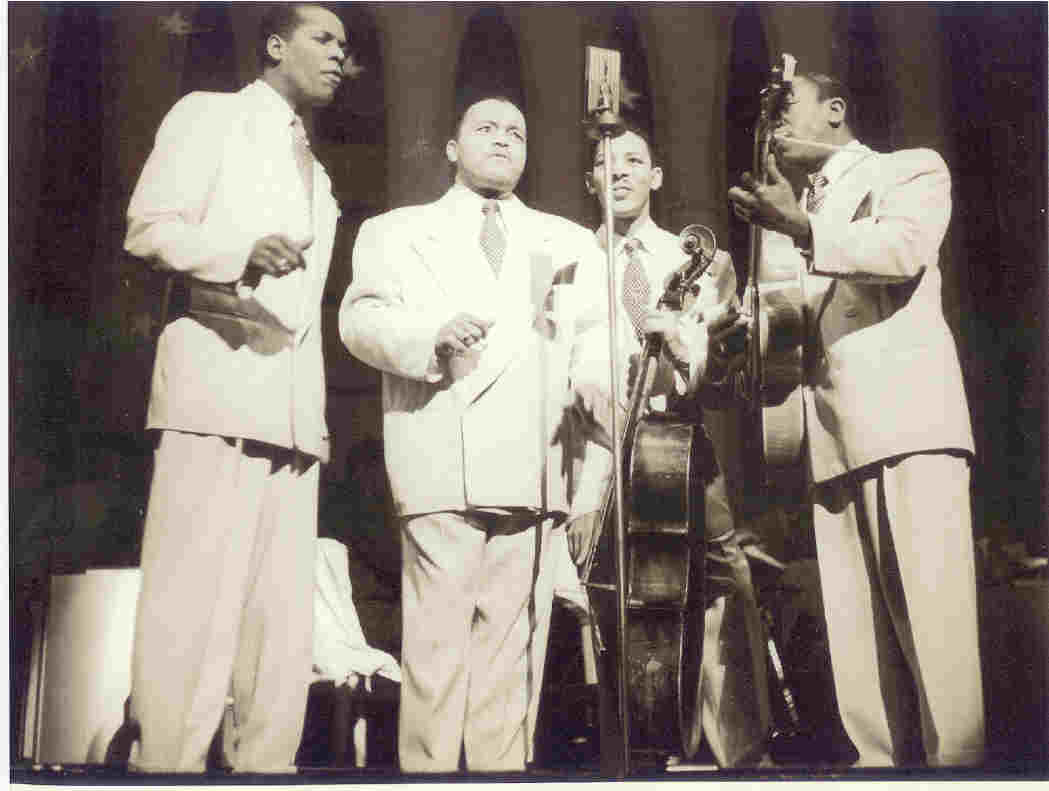 But you know what they say: “If it works, it works.” Or: “Go with what works.” The Ink Spots’ success led to a lot of recordings, “The Gypsy” being their greatest chart success, and collaborations with fellow future musical legends such as Ella Fitzgerald. In addition to this, they found their way into film, singing in The Great American Broadcast, singing such hits as “Alabamy Bound” and, not surprisingly, “If I Didn’t Care”. Later they were in Pardon My Sarong, an Abbott and Costello film where they portrayed singing waiters.
But like all good things (except for maybe Prince), things fall apart eventually. Charlie Fuqua was drafted in ’43, so he was replaced by Bernie Mackey. Jones, the bass singer and arguably the second most important person in the group, passed away after collapsing during a performance. This was probably the straw that broke the camel’s back. Kenny and Watson had beef, and Watson left the Ink Spots to form the Brown Dots (not a joke), and later he straight up formed another Ink Spots group. In Watson’s absence, Billy Bowen was brought in, and Jones was replaced by Cliff Givens, who himself was replaced by Herb Kenny, who was Bill Kenny’s twin brother. Mackey left too, and he was replaced by Huey Long. If this sounds like a saucy episode of Maury then yes, it was. Music is like that.
Fuqua was discharged and came back to the group, replacing Huey Long. Now the lineup, if you were confused, was Kenny, Bowen, Fuqua and the other Kenny. In the eary ’50s, Kenny 2.0 left and was replaced with Adriel McDonald. Bowen left a year later and he was replaced by Teddy Williams. Williams were gone for a while and Ernie Brown replaced him, and Fuqua left to make his own group that, you may be surprised to hear, was yet ANOTHER Ink Spots group. Remember that scene in The Godfather where Clemenza and Tessio asked the semi-retired Vito if they could form their own families? This is similar, but these guys could sing.
Now, long after everyone in the Ink Spots, original, legitimate or otherwise, are no longer with out, their popularity experienced a brief resurgence with the aforementioned video games and some welcome surprise appearances in shows like The Simpsons and that episode of The Walking Dead where Carol has to shoot her oblivious protege in the skull. Make no mistake, it wasn’t all that great an episode, even if they did do something unexpected.
When it comes to the Ink Spots, it was Bill Kenny’s show. Literally. He grew so popular that he started hosting a music TV show called The Bill Kenny Show, though this was long after the group disbanded. Musical aficionados will know about the group as a whole but the history of the Ink Spots is tied up in the life and times of Bill Kenny, whose story alone is worthy of an individual profile (foreshadowing). Even if you go to Wikipedia, the only other member of the Ink Spots you’ll find a page for is Huey Long, and the two most noteworthy things about him were how he was the last living member of the fabled group (passed away in 2009) and that he lived to be 105. Must be something in Texas. So Bill Kenny came in, messed with the format, brought the group to global fame, and went on to acquire the musical honorific of “The Godfather of Doo-Wop”. That’s quite a legacy.
And it all really began with a song that made me cringe when Redd Foxx sang it.

 Weight in Words: Redux
Thanks very pleased to have found your blog and this lovely tribute to a great group who still sound wonderful. I’ll be revisiting here. Regards from Thom at the immortal jukebox (drop a nickel).
LikeLike
Thank you for the read and the comment, my friend. Can’t say with confidence that I’ll cover a group like the Ink Spots again soon, but we’ll keep the site updated with fresh content. Always appreciate repeat visitors.
LikeLike
Great piece here! I am a huge Bill Kenny fan and Ink Spots fan. You wrote this very accurately and entertainingly. I especially like your relating the Ink Spots story to modern pop culture bits. Great humor in there! People talk about The Ink Spots but truthfully it was all (or mostly) about Bill Kenny. GREAT job here! 🙂
LikeLike
Thanks for checking it out! I’m pretty big on Kenny too; might do a piece devoted to him alone.
LikeLike